
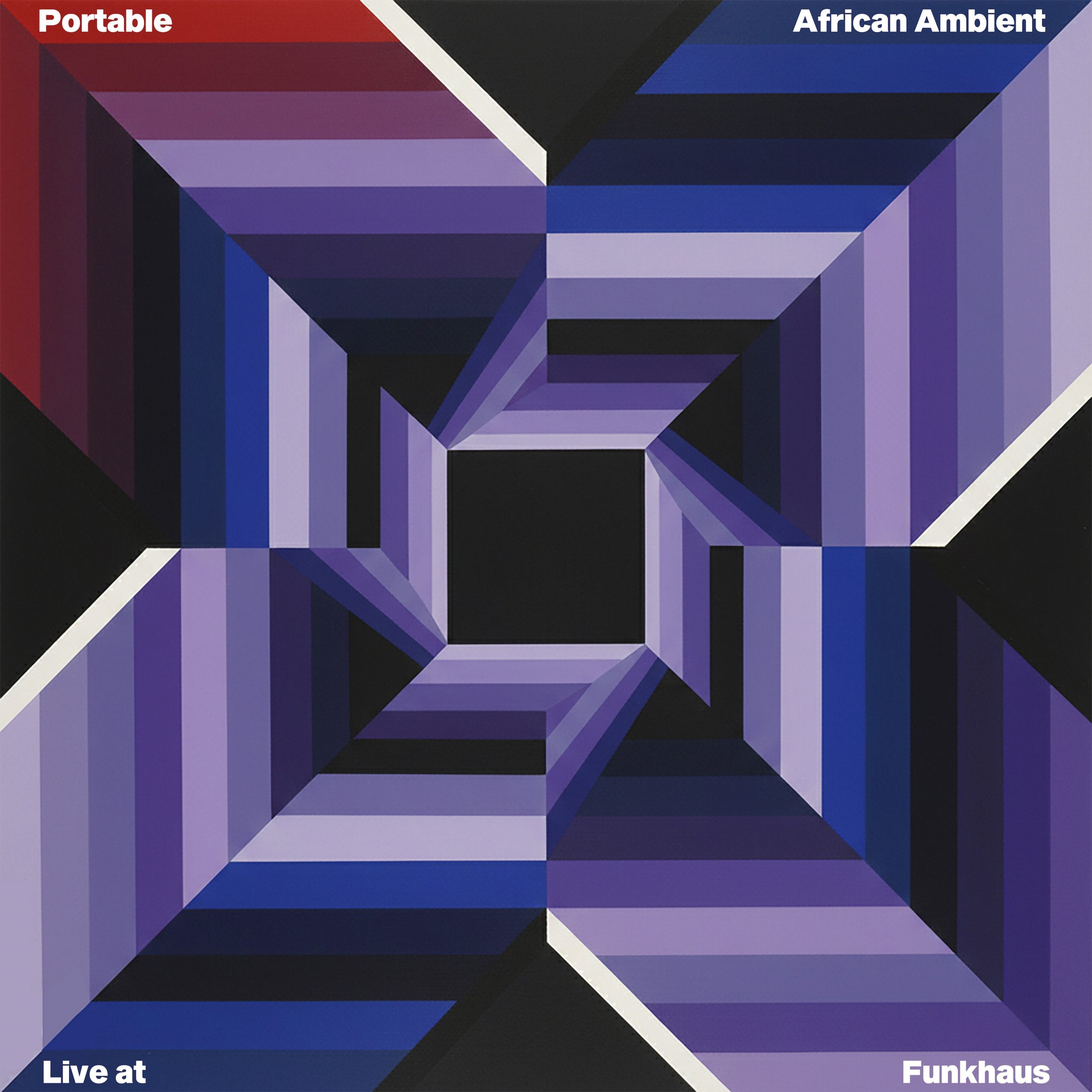
Alan Abrahams, a South African composer, producer, and singer based in Paris, has enjoyed a prolific career on the international electronic scene for over twenty years. Through his projects Bodycode, Portable, and under his own name, his albums explore different registers, ranging from dancefloor and techno tracks to minimal and house influences and numerous digital experiments, not to mention unique pop tracks marked by his deep, gravelly vocals. On this ninth LP from the Portable project, however, Abrahams embarks on a new stage in his career with a live recording at Berlin’s Funkhaus, a long ambient-inspired piece (composed of eight tracks, or eight parts), reminiscent of the innovative experiments of the electronica scene that saw him emerge in the 2000s.
Explorations around live performance
At the origin of this project, Alan Abrahams delved back into old hard drives from that era, where he was delighted to rediscover some of the sounds he had developed at the time, particularly sound textures close to ambient music, which encouraged him to continue in this direction.
After a few weeks of studio work, he put together a new live set, the first recording of which was noticed by the team at Resident Advisor and broadcast in spring 2024 in its “Mix of the Day” section. The success was immediate and quickly prompted promoters and festivals to invite him to play live, in particular the Giegling nomadic parties, which in the spring of 2024 took over Berlin’s prestigious Funkhaus, a magnificent complex of studios that once housed East German national radio. In a packed hall with wood-paneled walls and perfect acoustics, Alan appears on stage, without the aid of a computer, equipped with an Elektron synthesizer, two samplers, a slide guitar, and percussion instruments filtered through processing and effects (in particular Finegear’s Dust Collector). Throughout his concert, he composes, mixes, improvises, and spatializes an arsenal of motifs, layers, and textures, piano and vocal samples, deep bass lines, and sound design textures, allowing him to create a live soundscape that immerses the audience in a powerful bath of sensations and perceptions. At the end of his performance, the success was such that it prompted him to release the recording on the Parisian label Circus Company, the artist’s new partner since 2021.
African ambient music?
Although Alan naturally admires and cites among his influences the ambient music of Brian Eno and Harold Budd, pioneers of the genre, and the more elegiac sounds of 1980s dream pop (led by The Cocteau Twins), the artist explores a more personal dimension here, which he calls “African ambient” on this album, as if to assert his identity in the face of a genre that, since its birth in the 1970s, has developed primarily in Anglo-Saxon and European countries.
“Even though I left South Africa a long time ago, even though I am part of the diaspora and consider myself a citizen of the world (I am South African, British, and soon French), I have always composed my electronic music from what I consider to be an African perspective. Among the artists from my country of origin, I could of course mention the influence and sounds of an artist like Madosini, famous for her use of Xhosa ethnic instruments, but also the singer and activist Miriam Makeba, or even the influence of a more recent group like BCUC (Bantu Continua Uhuru Consciousness), which revisits certain little-known musical traditions with a modern twist. But beware, my music has nothing to do with the stereotypes sometimes associated with African music or what is known as world music. The African dimension of my music is more complex to describe. It can undoubtedly be found in my work on bass and distortion effects that I bring to certain sounds, which may, for example, evoke the sound treatment of guitars by some more traditional African musicians. Essentially, Alan advocates a form of modern and abstract Africanity, diasporic in nature, one might say, which draws on the techniques he has mastered since his first records were released in the early 2000s, but even more so on his heritage and culture of origin.
The youngest of ten children, young Alan Abrahams grew up near Cape Town in apartheid South Africa (abolished in 1991), nurturing a parallel passion for cinema and music, which he learned on the job. He grew up listening to Hilife music from Ghana, 1970s American soul, and musicians such as George Benson and Grover Washington Jr., while being equally captivated by the voices of Nat King Cole and Bill Withers as well as those of the English new wave, particularly Dave Gahan of Depeche Mode. In the second half of the 1980s, he discovered Chicago house music, which was very early on successful in South Africa, before leaving his country for the capital of London in the early 1990s. There, he became passionate about the electronic scene, before participating in the new wave of micro-house, experimental and electronica in the early 2000s. Productions from labels such as Context, ~scape, and the more famous Mille Plateaux prompted him to explore the creative potential of software and plug-ins, a requirement that is still present in his current music. “Yesterday as today, my ambition is to achieve a balance between sound design, percussion work, emotions, and chords.”
With this new album, he aims to continue in this vein. His “African ambient” approach is revealed in the form of music that is dense, immersive, and introspective, which, according to the artist, “proceeds in successive waves, alternating moments of calm and tension, close to a form of meditation, or why not like a sound shower or a powerful massage that, despite the pain it may cause, ultimately manages to transform you, relieve you and liberate you.”